


Restoring the Commonwealth — One Record at a Time
What is being undertaken by the People of The Commonwealth of Australia is not political reform, protest, or opposition to the corporate political society. It is not activism, and it is not conflict.
It is the lawful restoration of the Commonwealth by returning to its original foundation as a moral Nation constituted under a Public Trust — pursuant to the Commonwealth of Australia Constitution Act 1900 (Imperial) and the Declaration of Trust — “Commonwealth Public Trust” (13.04.2025).
A Commonwealth does not exist by legislation, policy, or administrative convenience. It exists only when the People themselves are known, counted, and standing in their own right. That was the original design.
Over time, this foundation was displaced by corporate systems that manage individuals through registrations, accounts, and digital profiles. Under those systems, standing is no longer declared; it is presumed. Allegiance is assumed. Authority is inverted.
The Electoral Roll is essential to restoration because it reverses that inversion. It places the People back on the public record as the source of authority. It fixes standing and allegiance openly and lawfully. It restores the proper order in which authority flows from the People upward, not from administration downward.
Without a lawful Electoral Roll, there can be no lawful Commonwealth — only management.
With it, the Commonwealth becomes visible, provable, and alive again.
Why Enrol on the Electoral Roll?
Enrolling on the Electoral Roll is not a political gesture.
It is a lawful act of standing.
It places your name, status, and allegiance on the public record so that nothing about you is left to presumption.
For centuries, free peoples have been known by the roll — not by accounts, registrations, or digital profiles. When you are on the roll, you are counted as one of the People, not merely managed as an administrative unit.
What the Electoral Roll Does...
It Places You on the Public Record
The Electoral Roll records who you are and where you stand.
In law, what is not declared may be presumed.
The Roll removes presumption and replaces it with fact.You are no longer undefined, misclassified, or assumed to belong to a system by default.
It Declares Allegiance and Standing
Allegiance determines jurisdiction.
By enrolling, you openly declare where your allegiance lies and under what authority you stand. This is foundational in constitutional, common, and natural law traditions.
Lawful authority flows from the People upward — not from policy downward.
It Establishes You as One of the People
There is a critical distinction between:
the People, who are the source of authority; and
participants in administrative systems, who are subject to rules.
The Electoral Roll records you as one of the People themselves, not merely as a user, customer, or managed individual.
It Protects Against Presumption and Silent Consent
Modern control rarely operates by force; it operates by default inclusion.
When a person is not clearly recorded, systems presume:
consent,
participation,
submission to conditions.
The Electoral Roll rebuts this quietly and lawfully.
You are known — not presumed.It Restores the Right to Choose
Enrolment does not create conflict.
It restores choice.You retain the ability to:
consent knowingly,
refuse lawfully,
require disclosure,
decline conditions without being labelled unlawful.
This is how free societies function.
What Staying in the Corporate System Means
Remaining solely within the corporate system is not wrong per se; however, it does carry consequences that are rarely explained.
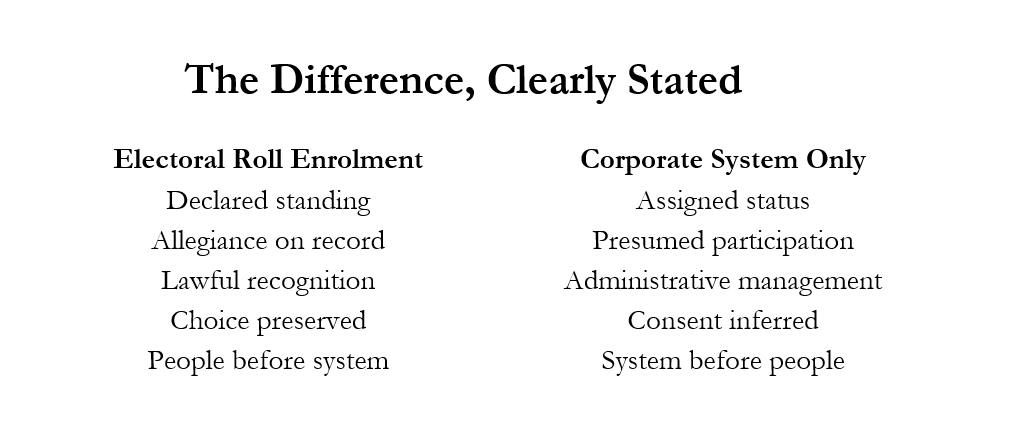
Over time, government shifted from a system grounded in allegiance, law, and the People, to one that operates as a managed corporate structure. Instead of recognising men and women by standing, it administers individuals through membership, registration, and participation. Most people did not knowingly choose this shift; they were enrolled into it by default.
You Are Treated as a Participant, Not One of the People
Corporate systems do not recognise inherent standing. They recognise participants.
If you remain solely within that system:
your status is assigned, not declared;
your obligations arise from policy and terms, not conscious consent;
your rights are conditional and revocable, not inherent.
You are managed as part of a system, not recognised as the source of authority.
Silence Is Taken as Agreement
Corporate systems depend on convenience and default inclusion. They assume agreement through:
automatic enrolment,
silence,
inaction,
continued use of services.
If you do not clearly state otherwise, the system presumes:
“You are part of this, and you accept its conditions.”
Once that presumption is in place, it becomes difficult to challenge, not because it is just, but because it is administratively efficient.
Access Becomes Conditional
Within corporate governance:
rights become permissions,
services become leverage,
identity becomes access-based.
Digital identities, accounts, and platforms exist to authenticate compliance, not to recognise who you are in law. Access can be limited, suspended, or withdrawn without addressing your standing as a man or woman.
Objection Is Reframed as “Non-Compliance”
When your standing is undefined, objection is not understood as a lawful act — it is treated as non-compliance.
Refusal becomes:
a breach of policy,
a failure to comply,
a denial of service.
Not because you are acting unlawfully, but because the system has no framework to recognise lawful dissent from within its own rules.
You Are Governed by Policy, Not Law
Corporate systems are policy-driven, not conscience-driven.
Policies can change without notice.
Terms can be updated without consent.
Conditions can be imposed without remedy.
This model is efficient, scalable, and profitable — but it is not liberty.
This Is Not About Rebellion
Enrolling on the Electoral Roll is rightful, lawful, orderly, traditional, and peaceful. It does not attack, reform, or interfere with any political society or its institutions; it simply restores proper order and standing. Throughout history, free peoples did not preserve liberty through riots or rebellion — they preserved it by standing on their rights.
A Simple Truth
If you are not on the Roll, you are presumed to be a willing participant in the corporate society and therefore subject to corporate jurisdiction: you are treated as a legal person or surety, managed and governed as legally incapable of acting outside prescribed permissions, and categorised for administrative convenience as a commodity or human resource. If you are on the Commonwealth Roll, you are known as a living man or woman, recognised and counted as self-governing, competent to manage your own affairs and Estate, and standing both in law and in fact within The Commonwealth under its original constitutional jurisdiction.
We all possess freedom of will, association, and choice.
The choice is yours. It always has been.
Free men free themselves, while slaves wait to be freed.
Enrolment
The Importance of Your Commonwealth Signature
Enrolment on the Commonwealth Electoral Roll is a formal, evidentiary process.
Each step below must be completed deliberately and in proper order.
When you enrol on the Commonwealth Electoral Roll, you are not merely completing paperwork. You are placing evidence of your standing, allegiance, and capacity on the public record. For that reason, the way you sign matters.
Most people’s everyday signatures have been shaped over time to operate within administrative and corporate systems. Those signatures are commonly treated as acting for a legal or administrative “person.” Commonwealth documents require a different approach — one that reflects you acting knowingly, deliberately, and in declared capacity.
Your Commonwealth signature is not symbolic. It is evidentiary. It distinguishes the living man or woman from any corporate or administrative construct and fixes responsibility, authority, and intent on the record.
Once adopted, this signature must be used consistently on all Commonwealth documents. Consistency establishes continuity of identity, prevents later mischaracterisation, and strengthens the evidentiary value of the record. Changing signatures undermines evidentiary continuity; a settled autograph strengthens standing.
Example: By: John-james, Executor
What Your Commonwealth Signature Represents
Your Commonwealth signature is:
an autograph (living handwriting, not block capitals),
made with full knowledge and intent,
executed in a declared capacity.
It clearly distinguishes:
the living man or woman,
fromany corporate, administrative, or legal fiction.
Every signature is made in capacity. Capacity answers the question:
“In what authority are you acting?”
Without declared capacity, signatures are easily misused or mischaracterised.
With declared capacity, liability and presumption are contained.
Step 1 — Choose the Correct Statutory Declaration (AA / AB / BA / BB / CA / CB)
Open this page first and carefully read the available forms to determine which Electoral Roll Statutory Declaration matches your circumstances.
Before signing with a Commonwealth Justice of the Peace, you must have read and understood the document you intend to sign.
Step 2 — Prepare your Commonwealth Signature & Identification (required)
Before you sign, download and follow the step-by-step instructions for:
your Commonwealth autograph (with declared capacity)
thumbprint application (where required)
head-and-shoulders photograph requirements
Application checklist (so your record is clean, consistent and correct)

Download the PDF — Commonwealth Signature & Identification Instructions
Commonwealth Election Roll
Once you have read the Statutory Declarations and prepared your Commonwealth signature and identification, the next step is to complete the appropriate Electoral Roll application form.
The forms are grouped according to where you were born and your current status, so that your standing and allegiance are recorded accurately and without presumption. Choose the form that correctly reflects your circumstances and complete it carefully.
Born Within the Commonwealth of Australia
Forms AA – ABBorn Within the British Commonwealth (outside Australia)
Forms BA – BBBorn Outside the British Commonwealth
Forms CA – CB
Each form records your details, allows you to upload your signature sample and photograph, and initiates preparation of your Statutory Declaration for signing and witnessing.
Select the correct form below:
Click here for Forms AA – AB
Click here for Forms BA – BB
Click here for Forms CA – CB
Take your time.
Accuracy at this stage ensures your record is clean, correct, and complete.
Standing is established by proper form and clear record.